Carbon Credit Trading Services
Turn Carbon Reduction into Measurable Business Value
ECS helps businesses participate confidently in India’s evolving carbon market. From identifying eligible projects to carbon credit registration, verification and trading support, we simplify every stage of the carbon market journey.
Our specialists combine regulatory knowledge, carbon accounting and market insights to help your organisation generate, purchase or manage credible carbon credits.
What Is Carbon Credit Trading?
Carbon credit trading allows organisations to buy and sell verified greenhouse gas emission reductions or removals. One carbon credit typically represents one metric tonne of carbon dioxide equivalent (tCO₂e).
Businesses that reduce emissions beyond applicable targets may generate credits, while organisations facing an emissions shortfall may purchase eligible credits. This creates a financial incentive for energy efficiency, cleaner technologies and climate-positive projects.
India’s Carbon Credit Trading Scheme includes compliance and offset mechanisms, with certificates issued through the Indian Carbon Market Registry and traded electronically. Bureau of Energy Efficiency
Our Carbon Market Services
- Carbon Project Assessment : We assess your operations and proposed projects to identify eligible emission-reduction and carbon-credit opportunities.
- Carbon Footprint and Baseline Development : Our team measures greenhouse gas emissions and establishes credible baselines using applicable methodologies.
- Project Registration Support : We assist with documentation, methodology selection and project registration under relevant carbon-market programmes.
- MRV and Verification Assistance : Get expert support for monitoring, reporting and verification to demonstrate transparent and measurable emission reductions.
- Carbon Credit Trading Advisory: We help you evaluate credit quality, market options, pricing considerations and transaction risks before buying or selling credits.
- Compliance and Portfolio Management : ECS supports obligated and voluntary participants with credit procurement, retirement, record management and regulatory readiness.
Carbon Market Opportunities Across Sectors
We support eligible projects across:
- Renewable energy and energy efficiency
- Manufacturing and industrial processes
- Waste management and methane reduction
- Agriculture and forestry
- Sustainable transportation
- Fuel switching and clean technologies
- Carbon removal and nature-based solutions
Project eligibility depends on the applicable methodology, additionality, baseline and verification requirements.
Why Work With ECS?
- End-to-end carbon market support
- Strong understanding of Indian environmental regulations
- Transparent and evidence-based project evaluation
- Support for credible MRV and third-party verification
- Sector-specific carbon reduction expertise
- Focus on environmental integrity and commercial value
We help ensure that every carbon-market decision is supported by reliable data, appropriate due diligence and clear documentation.
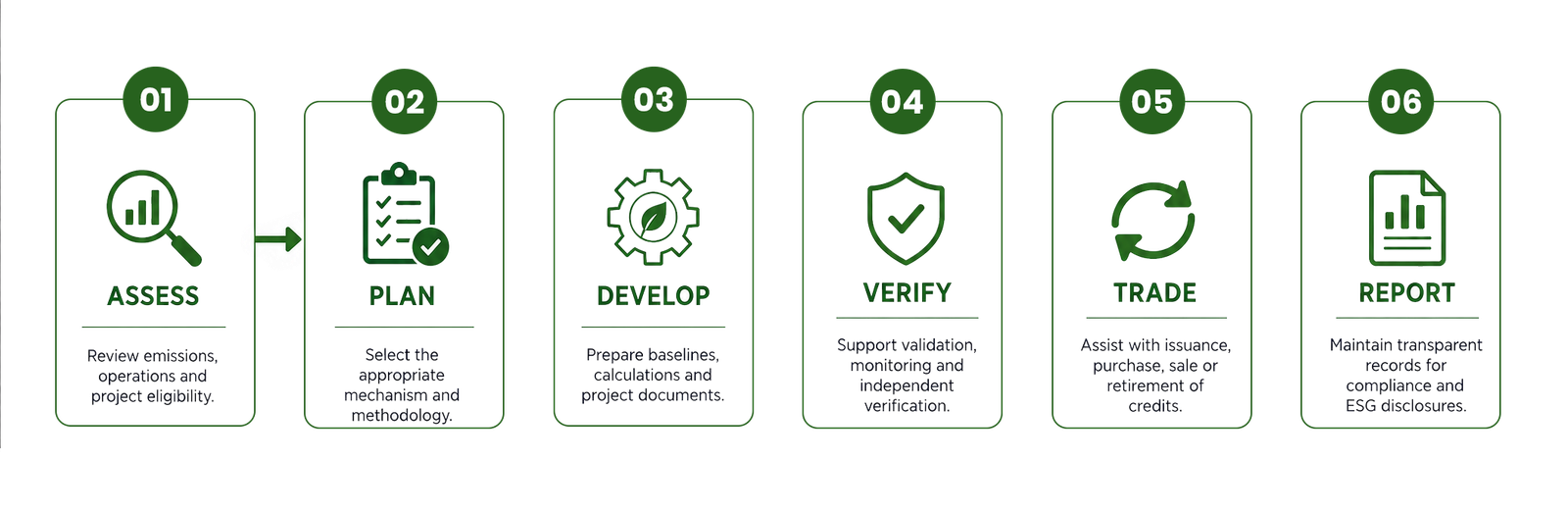
OUR PROCESS
From Assessment to Verified Carbon Credits
FAQs
What is one carbon credit worth?
A carbon credit generally represents one metric tonne of CO₂e reduced, avoided or removed. Its market price depends on the project type, methodology, vintage, quality and demand.
Who can generate carbon credits in India?
Eligible obligated and non-obligated entities may generate Carbon Credit Certificates according to the relevant mechanism, approved sector and methodology.
Can ECS help us sell carbon credits?
Yes. ECS can support project assessment, documentation, verification readiness, credit issuance and market evaluation.
What is MRV in carbon markets?
MRV means monitoring, reporting and verification. It ensures that claimed emission reductions are accurately measured, documented and independently verified.
Are voluntary and compliance carbon markets different?
Yes. Compliance markets operate under mandatory regulations, while voluntary markets allow organisations to purchase credits voluntarily in support of climate objectives.